
Objectives
Choose your path in the sector
The specific objectives achieved by students taking the Master’s degree are flexible, in the sense that, during the professional training stage at our centers (INTA’s CEUS and CEDEA, and the UHU’s Higher Technical School of Engineering), as well as during the completion of the Master’s Thesis at these centers, they can acquire specialized training within the wide range of technologies involved in the aerospace sector. However, in general, the following specific objectives are established:
Fundamentals and context
Introductory knowledge of the UAS environment, market, and general landscape.
- Fundamentals of atmosphere and meteorology applied to aviation.
- Global vision of the scientific, technological, and professional field of UAS.
- Typology, applications, industry, and evolution of the UAS sector.
Operation and systems
Basic principles of UAS flight, control, and technical components.
- UAS operation in all flight phases.
- Onboard control, electrical, electronic, and propulsion systems.
- Batteries and supercapacitors applied to UAS.
Analysis and performance
Evaluation of the dynamic and operational behavior of UAS in flight.
- UAS performance, stability, and trajectories.
- Flight operations analysis.
- Fundamentals of rotary-wing UAS flight.
Navigation
Systems and regulations related to navigation, routes, and aerial communication.
- Air navigation principles and systems.
- Flight path planning.
- Onboard networks and communications with their regulations.
- UAS integration into the airspace.
Design and maintenance
Key design, regulation, certification, and technical support processes.
- UAS design and manufacturing.
- Maintenance and technical inspection.
- Regulations, qualification, and certification.
- Payload management and applications.
Advanced applications
Technological tools for advanced and simulated UAS operation.
- Instrumentation and data fusion.
- Applied modeling and simulation.
- Perception and computer vision systems.
- Interpretation of meteorological information.
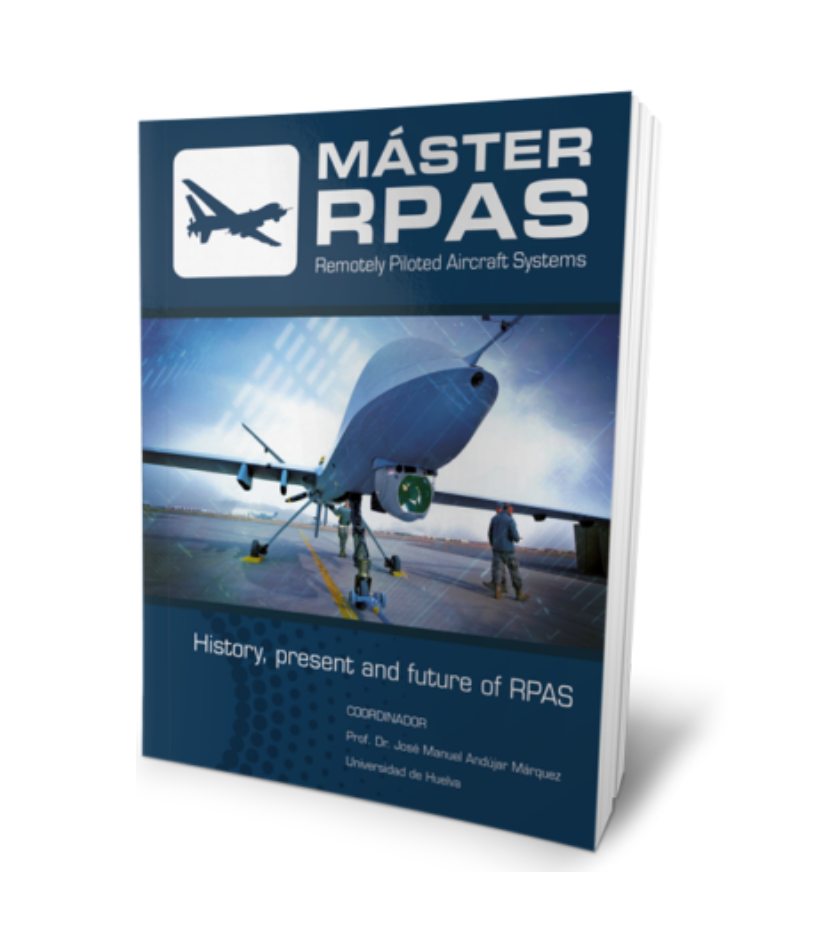

History, present, and future of RPAS
- Origin of the first RPAS
- Analysis of an emerging sector
- Career outlook
Find Answers to Your Questions
Who is the Master's program for?
The recommended profile for admission to the Master’s program is to hold a university degree in Engineering, Sciences, or equivalent. However, the Academic Committee of the Master’s program may consider other academic qualifications for admission, subject to prior analysis of the student’s curriculum.
For students who have not yet completed their university studies but are close to doing so, the Master’s Academic Committee may authorize enrollment. However, once the Master’s program is completed, they will not be able to apply for the degree until official documentation confirming the completion of their undergraduate degree is provided. In the meantime, the Master’s Secretariat may issue a certificate confirming successful completion of the program.
Where is the Master's program taught?
The Master’s program is taught primarily at the Higher Technical School of Engineering of the University of Huelva (Huelva) and at the “CEUS-CEDEA” centers of the National Institute of Aerospace Technology (Municipality of Moguer).
How long does the Master's program last?
The Master’s program has a duration of 450 hours distributed over approximately 8 months (from November to June of the following year). The course, comprising academic and practical activities at the University of Huelva and the National Institute of Aerospace Technology (INTA), begins in early November and ends in late June of the following year. Throughout the entire course, students will carry out the Master’s Final Project.
What career opportunities does it offer?
- Design and construction of civil and military RPAS.
- Propulsion, power sources, and energy.
- Control, navigation, and simulation systems.
- Avionics, communications, and networks.
- Civil and military payloads.
- Operations and maintenance of civil and military RPAS.
- Regulations, qualification, and certification of RPAS.
- Entrepreneurship option for creating your own company.
What is the cost of the Master's program?
The Master’s program costs €6,000, which can be paid in 2 installments.
How many students are admitted per academic year?
Each edition of the Master’s program admits a maximum of 30 students in order to ensure training quality and individualized monitoring of each student.
How are students selected?
When pre-registering, the student must submit documentation regarding their university education and curriculum vitae which, once analyzed by the Academic Committee of the Master’s program, allows establishing an order of priority for enrollment. The student is personally informed of the process at all times.
When does the academic year begin and end?
Academic and practical activities at the University of Huelva (UHU) and the National Institute of Aerospace Technology (INTA) begin in early November and end in late June of the following year. Throughout the entire course, students will carry out the Master’s Final Project.
What professional competencies will I acquire in the Master's program?
- Have basic knowledge of atmosphere and meteorology.
- Acquire knowledge of meteorology applied to aviation.
- Know information sources that show predictions of atmospheric behavior, as well as their interpretation.
- Understand how a UAS flies in all phases of flight.
- Analyze UAS performance.
- Understand how a UAS is controlled.
- Know the control techniques and systems applicable to UAS.
- Analyze UAS stability.
- Understand how the UAS responds to the actuation of control surfaces.
Analyze flight trajectories. - Analyze flight operations.
- Understand the fundamentals of rotary-wing UAS flight.
- Understand the fundamentals of propulsive force generation in aircraft.
- Know the air navigation system.
- Understand how different navigation systems work.
- Perform route planning.
- Know the basic fundamentals of electrical and electronic systems onboard a UAS.
- Know the classification, typology, applications, industry, and market of UAS.
- Understand the fundamentals of batteries and supercapacitors.
- Know the particularities of power plants for UAS.
- Know the regulations and rules for the integration of UAS into airspace.
- Know the systems for the integration of UAS into airspace.
- Know the regulations and processes for the qualification and certification of UAS.
- Know the fundamentals of design and manufacturing processes of UAS.
- Know the techniques and processes for UAS maintenance.
- Know the advanced applications of UAS.
- Know the instrumentation and data fusion techniques applicable to UAS.
- Know the modeling and simulation techniques applicable to UAS.
- Know communication systems and networks and their regulations.
- Know and be able to integrate payloads applicable to UAS.
- Have a general overview of perception systems that can be integrated into UAS, as well as computer vision techniques for their maximum exploitation.
- Have a general overview of the scientific, technological, and commercial scope of UAS.
- Have a general overview of employment opportunities in the field of UAS.
- Have a general overview of the development prospects for UAS technologies and market.
- Know how to perform technical inspections with UAS.
Make an Inquiry
"*" indicates required fields

